


CANT WE ALL JUST GET ALONG?
“Environmental spending creates jobs in engineering, manufacturing, construction, materials, operations and maintenance.” – Keith Ellison

I must admit, this was a real cranium scratcher. Imagine for a minute, that two fighters came to the ring. One fighter represented a Mining Engineering Firm and the other represented Mother Nature. Who do you think would win?
Let me break it down even further, lets say that the Mining Engineering Firm boxer has had money thrown at him to train, has designed a system that creates profits through sponsorship whilst Mother Nature representative has only had water, sunlight and food scraps to live off. Would that change your betting on sports bet?
I’ll add another scenario what if this wasn’t an arranged fight but a street fight. In order to protect each incoming blow from occurring a bystander representing ‘compromise’ came in to the foray of shouts and prelude to try and talk each fighter down. So big strong Mining Engineering firm guy has backing and sponsorship and Mother Nature doesn’t, why should he want to back down?
What if I was to tell you the Mining Engineering firm boxer was a metaphor for capitalism and Mother Nature meant the environment and ecosystems around the world? The compromise that would be left needs a way to be able to coexist in a way that neither side had to perish, which brings me to the concept of Ecological Engineering.
What is Ecological Engineering???
Ecological Engineering defines an exciting relationship that exists between Engineering Design and Nature. It explores how we can use Engineering Design in a respectful way that can both mutually benefit the Environment but also the Engineers project itself.
To expand on this further Engineering design is morally done to benefit human welfare; however, this sometimes interferes with the local Environment and therefore it is encumbered upon the designers to create sustainable systems. It is also a crucial development in the field of engineering as conventional energy sources diminish and the dependency on the ecosystems services is increased (William, J. Mitsch, 2012). So ultimately like my format for study, principles will need to be adopted so that Ecological Engineering isn’t just a buzzword, but rather a set of strategies and goals set forth to ensure sustainable practices are adopted.
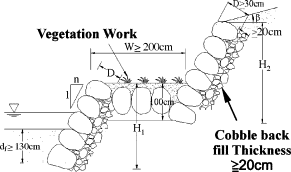
Ecological Engineering Principles
Ecological Principles are a set of guidelines on how to create an engineering design that caters for both the aspect of human welfare but also the Environmental and Ecological Systems that may be directly or indirectly impacted by activities during and after design is completed which is important to preserve both design and habitat. These designs could include things like: waste water facilities, water supply stations – which are considered essential facilities for promoting sanitation and overall human health (and importantly mine). Principles used in designs are broken up into five areas that are guiding for practicing ecological engineering with the underlying requirement that for a successful project in this area; both the organism (including humans) relationships are observed but also it integrates the well-being of both human society and the natural environment with benefits for both according to Scott D Bergen et al (2016).
Measuring the success/failure of Ecological Engineering Principles
A journal report on Restoration for ecological systems describes the process of restoration as, “the process of assisting the recovery of an ecosystem that has been degraded, damaged or destroyed”. So with this definition in mind, we have a sort of warning statement that if we want to avoid further costs (both financially and Environmentally) we have to ensure our design doesn’t follow the three D’s (degrade, damage or destroy).
In my opunion (yeah i didn’t misspell) a great example of this idea I found through an Engineering Company, where they pitch the idea in one of their blogs which looks at creating forest strategy for urban environments. This is done in order to combat the issue of climate change, population growth and urban heating.
So in these two examples of literature it can be clear to see that measures can already be formulated. If we want to see a measure of success or failure we need to look around us before a project and after. What have we impacted? In one instance we could look at the biodiversity of the ecosystem. In another we can look at the temperature changes in a localised area where restorative planting and watering has occurred. So we can already see that we can have our cake and eat it too (and both boxers escape injury).
Engineering Ecosystem Management
The common view I have observed from my time working as an engineer, is that when it comes to management on the issues of the Ecosystems, liabilities seem to run and stop at the following conversation, “avoid cutting that tree down its protected”. Not exactly robust or thought provoking on the other issues of micro-organisms, plant diversification and other terms I’ve heard relating to the environment. It’s important especially in an engineering environment that a top-down approach is adopted to create the belief/culture that the environment is just as important as the project that is being worked on rather than a nuisance to tick off on a checklist.
I wont lie, this next bit blew my mind. In Engineering design a commonality for management and designers is the thought provoking questions of, “what services do we need?” That has been a common question in design with the answers often ranging from MRWA, Dial before you dig, Water Corp etc. These services often cost with management and create headaches over rules and regulations. But lets just imagine for a moment? Had your moment… Great! That we can use the environment to do those services for us and benefit?! In fact Freddy Rey et al. (2015) describes a fascinating assertion that contrary to Civil Engineering practices, Biological Services (harnessed by Ecological Engineering) will continue to grow even in the long run.
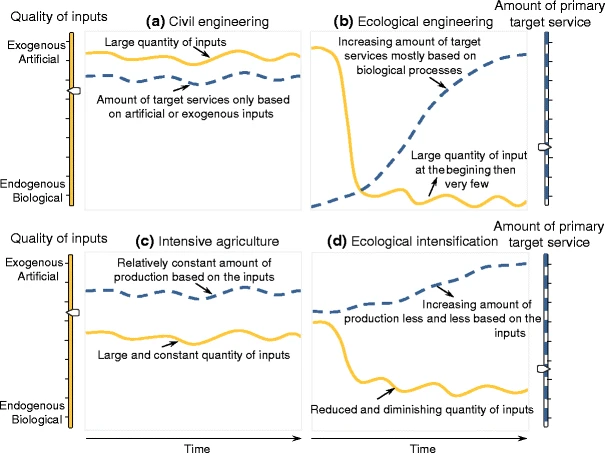
Integrating Ecological Engineering Principles Into Design
So this is a shoutout back to the five principles of Ecological Engineering which are discussed in depth by Scott D. Bergen et al. (2001). I wont go into depth on what the principles are but a few points I’ve thought of whilst reading them have come to mind.
The first principle which ironically is entitled: design consistent with ecological principles, makes me think of the concepts of engineering resilience and ecological resilience (again discussed by Scott D. Bergen et al.) These principles could be kept in mind for the designer as one in the same for the project by asking the question of, “how far can I push this design before disruption to its performance and the local ecological environment is disrupted negatively?” I found a company Mannvit that does a great job of displaying this on their company header for buildings.
The second Principle: Design for site-specific context, I believe can be summarised into three questions 1) What is here? 2) What will nature let us do here? and 3) What can the ecology here help us do here?. Out of the three questions I am of the opinion the first question is the most important. The CWD group employs Environmental engineers that ask these questions constantly of fusing ecology with their designs.
Principles 3 and 4 I have combined (just for fun): Maintain Independence in design and design functional requirements and designing for efficiency in energy. This for me spells the importance of where possible keeping your design simple as nature can be anything but, so when looking for assistance from nature in helping your design work measures including efficiency can be unpredictable if not chaotic. The Engineering company ARUP does I feel a really great representation on their page when they boast about creating buildings that are efficient with resources whilst also meeting the needs of the environment.
Finally the fifth principle: Acknowledging the values and purposes that motivate design. I believe this speaks to what I previously discussed of creating a design that is both beneficial to human use but also to the ecosystem and environment. I believe the companies I have mentioned above in some way cover all those requirements in their designs.
Native Cultural Awareness and Sustainable Development Goals (SDG’s)
The Aboriginal People of Australia thought of themselves as conservationists of the land and therefore were duty bound to respect the land and wildlife because they were sharing it (i.e. not hunting when animals were feeding etc).
“Aboriginal management regimes typically aimed to maintain the abundance and diversity of food and other resources within the environment and fulfilled goals such as cleaning (burning) the country to make lands accessible” (Russell-Smith et al. 1997, Walsh 2008)
Having listened to Professor Richard Walley (an Aboriginal Elder) my notion of sustainable practices were put to the test. His talk on trigger points and the idea that nature wasn’t there to just serve us humans but also the ecosystem so it was important to respect the populations. An example given was, Aboriginal People didn’t hunt in the morning because it would interfere with the wildlifes feeding times, and they moved around to allow for sustainability of populations of ecosystems and to avoid an negative impact on the habitat. The notion of sustainability it seems it based on a notion of saving the environment for future generations. However, i would argue that is a self-centered view based on the discussion. You see Professor Walley’s Native cultural perceptions made it clear to me that the reasons behind sustainability should be for more than just the betterment of human kind, but of the nature and wildlife as well.
Speaking to the nature and wildlife this brings me to my next point. Sustainable Development goals, which are a set of goals agreed to by the united nations that promotes social well being and the protection of the environment. It wasn’t good enough i felt to look at this through the lenses of a Environmentalist, but rather an engineers perspective. Reading a very interesting article by Shahin Rahimifard and Hand Trollman (2018), they go into great depth the challenges and goals we as engineers should face in the future going forward. That isn’t to say we haven’t made strides in my humble opinion; however, i found two points in this article that really struck a chord. The first is to create complex systems to meet the complex demand of SDG’s (so in that vein i believe we can improve education). The second is for Engineers to challenge themselves to meet the needs of a growing population while minimizing the pressure on earths resources. This last point i believe ties in well to the native culture and SDG’s through the vessel of Engineering.
Conclusion
So by now i feel that i have exhausted both myself and you the reader. So like any great TV saga lets wrap it up. In this blog my aim was to explore the two competing issues that are prevalent in today’s society. The first being boxer A Capitalism (AKA mining engineer firm) and then boxer B (AKA Mother Nature at her finest) and to examine the mediator which i argued is the Ecological Engineer. I felt it important to examine the Ecological Engineers role in society and how this could interlink with future designs by using nature as a partner rather than a nuisance accompanied with red tape (EPA). Further to this, accompanying Engineering design was the motivating factor (or mission statements) of both the SDG’s and Native culture helped to formalize the importance of protecting and considering nature in engineering design. So in reference to my earlier question about the boxers, do you think that it’s a question of who will win but rather what we have to loose?
I shall close this blog with a joke: did you hear about the new ecological engineering initiative about making glass trees for the environment? Yeah it’s effects remain to be seen.
#EcologicalEngineerThePeacemaker
 YouPutWHATInY(our)water?!?
Interesting read, liked the boxer analogy!
LikeLike
Float like a butterfly, sting with the bee 😉 Using nature to help you with your design process is a really interesting topic and definitely something we should harness in our future as engineers, thanks Alan!
LikeLike
Emjoyed the boxing analogy 🙂
LikeLike